Abstract
Unraveling genetic variability and diversity for the enhancement of yield and yield contributing traits in finger millet (Eleusine coracana L.) under semi arid climatic niches.
Author(s): Jhansi Rani P*, Srinivasa Rao R, Sameer Kumar CV, Srinivasa Reddy IV, Hemantha Kumar JThe study assessed genetic variability, heritability, correlations, path analysis, and genetic diversity among 31 finger millet (Eleusine coracana L.) germplasm accessions, including two checks, evaluated under a randomized block design at the Regional Agricultural Research Station, Palem. Significant differences were observed across most of the eleven yield and yield contributing traits, highlighting the presence of substantial genetic diversity. Traits such as grain yield, fodder yield, plant population per plot, and 1000-grain weight exhibited high genetic variability, heritability, and genetic advance, suggesting the predominance of additive gene effects and their suitability for direct selection. Correlation analysis revealed significant positive associations of grain yield with plant population per plot, number of productive tillers per plot, and fodder yield, underscoring their importance in yield improvement. Path analysis further confirmed that plant population per plot and number of productive tillers per plot exerted significant positive effects on grain yield. Principal component and cluster analyses validated the high diversity, identifying several promising genotypes for yield enhancement. Notable donors included VR-1131, VR-1147, VR-1150, GPU-67, and VR-1174. Crosses among divergent clusters are expected to generate superior progenies. Overall, the findings provide valuable insights for strategic parent selection and targeted breeding programs aimed at enhancing productivity in finger millet.
Impact Factor an Index
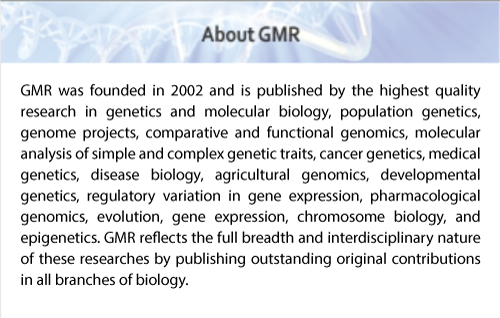
Google scholar citation report
Citations : 74024
Genetics and Molecular Research received 74024 citations as per google scholar report