Abstract
The exploration of potential relationship between COPD and LUAD based on single-cell sequencing and bulk transcriptome sequencing
Author(s): Yanjiao Zhang*, Yicheng LiangBackground: Lung Adenocarcinoma (LUAD) and Chronic Obstructive Pulmonary Disease (COPD) are lung diseases that may share some common etiological factors and mechanisms. Epithelial-Mesenchymal Transition (EMT) plays an essential role in regulating numerous physiological and pathological processes. This study aimed to evaluate potential relationship between LUAD and COPD patients based on single-cell sequencing data combined with bulk transcriptome sequencing data from the perspective of EMT, which may help to provide potential new biomarkers for diagnostic and therapeutic purposes.
Methods: First, we obtained single cell sequencing data from the GEO database for LUAD patients and COPD. Subsequently, single-cell dimensionality reduction annotation analysis was performed. By differentially expressed gene analysis, we identified marker genes for each cell subset. Based on the hallmark gene set, we explored the expression of relevant pathways in LUAD. Subsequently, we assessed immune cell components in both patient cohorts based on bulk transcriptome sequencing data. Venn diagram was used to identify intersection genes of genes associated with EMT pathway in LUAD and COPD patients. GO and KEGG enriched pathway analysis was performed. The hub gene was identified by Protein-Protein Interaction (PPI) analysis. Subsequently, we performed ROC analysis, correlation analysis, expression analysis, immune cell correlation analysis, and their expression at the single-cell level for the hub gene, respectively. Finally, we predicted compounds and drugs with potential therapeutic effects based on hub and showed their two-dimensional molecular structures.
Results: Based on single-cell sequencing results, we annotated LUAD tissues as four cell types and COPD tissues as eight cell types. By pathway analysis, we found significant activation of the EMT pathway in endothelial cells from LUAD patients. Endothelial-to-Mesenchymal Transition (EndMT) is a special type of EMT. Therefore, we intersected endothelial cell signature genes from LUAD patients and COPD patients with EMT pathway-related genes and obtained 12 genes. Through pathway analysis, we found that these genes were significantly enriched in collagen-activated signaling pathways, actin-binding related pathways, and ECM-receptor interaction pathways. By PPI analysis, we identified six hub genes, the majority of which were significantly expressed at different levels in both LUAD and COPD compared to normal tissues. In addition, we found that CALD1, COL4A1, COL4A2, MYLK, and SPARC were higher in LUAD, which may be helpful in diagnosing LUAD. Meanwhile, TPM4 was higher in COPD, which may help to diagnose COPD and had a significant association with immune cell components. Finally, we screened eight drugs with potential therapeutic effects on LUAD and COPD.
Conclusion: In this study, we identify potential relationship between LUAD and COPD based on single-cell sequencing data combined with bulk transcriptome sequencing data from the perspective of EMT. These biomarkers not only have good performance, they also show a significant association with immune components. Our study provides novel tools potentially used as biomarkers for diagnostic therapeutic purposes and a novel perspective of the relationship between LUAD and COPD.
Impact Factor an Index
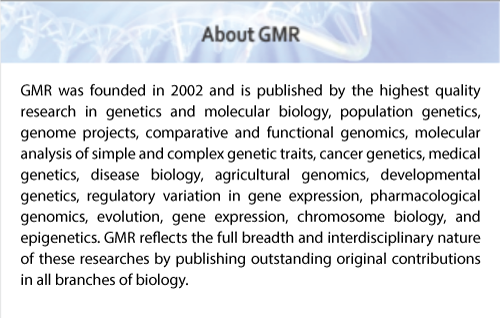
Google scholar citation report
Citations : 74024
Genetics and Molecular Research received 74024 citations as per google scholar report