Abstract
Genetic relationships among five varieties of Curcuma alismatifolia (Zingiberaceae) based on ISSR markers
Author(s): S. Taheri T.L. Abdullah N.A.P. Abdullah Z. AhmadThe genus Curcuma is a member of the ginger family (Zingiberaceae) that has recently become popular for use as flowering pot plants, both indoors and as patio and landscape plants. We used PCR-based molecular markers (ISSRs) to assess genetic variation and relationships between five varieties of curcuma (Curcuma alismatifolia) cultivated in Malaysia. Sixteen ISSR primers generated 139 amplified fragments, of which 77% had high polymorphism among these varieties. These markers were used to estimate genetic similarity among the varieties using JaccardâÂ?Â?s similarity coefficient. The similarity matrix was used to construct a dendrogram, and a principal component plot was developed to examine genetic relationships among varieties. Similarity coefficient values ranged from 0.40 to 0.58 (with a mean of 0.5) among the five varieties. The mean value of number of observed alleles, number of effective alleles, mean NeiâÂ?Â?s gene diversity, and ShannonâÂ?Â?s information index were 8.69, 1.48, 0.29, and 0.43, respectively. The genus Curcuma is a member of the ginger family (Zingiberaceae) that has recently become popular for use as flowering pot plants, both indoors and as patio and landscape plants. We used PCR-based molecular markers (ISSRs) to assess genetic variation and relationships between five varieties of curcuma (Curcuma alismatifolia) cultivated in Malaysia. Sixteen ISSR primers generated 139 amplified fragments, of which 77% had high polymorphism among these varieties. These markers were used to estimate genetic similarity among the varieties using JaccardâÂ?Â?s similarity coefficient. The similarity matrix was used to construct a dendrogram, and a principal component plot was developed to examine genetic relationships among varieties. Similarity coefficient values ranged from 0.40 to 0.58 (with a mean of 0.5) among the five varieties. The mean value of number of observed alleles, number of effective alleles, mean NeiâÂ?Â?s gene diversity, and ShannonâÂ?Â?s information index were 8.69, 1.48, 0.29, and 0.43, respectively.
Impact Factor an Index
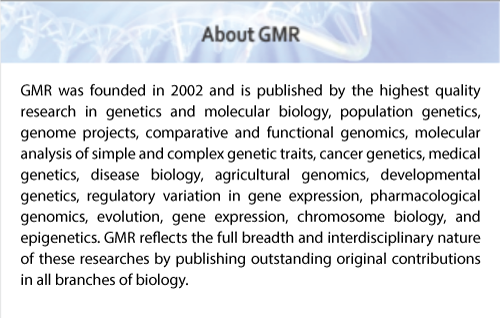
Google scholar citation report
Citations : 74024
Genetics and Molecular Research received 74024 citations as per google scholar report