Abstract
Comparison of the Effectiveness of Red and Yellow Watermelon Extracts as Natural Tooth Bleaching Agents on Discolored Teeth
Author(s): Sari Dewiyani*, Ihsan Firdaus, Niekla Survia Andiesta, Ida Ayu Janna Jayanti MaharaniBackground: Red and yellow watermelon (Citrullus lanatus) cultivars may differ in their metabolite composition. Such differences could be relevant to the biological properties of their extracts, although the contribution of individual compounds to tooth-colour change has not been established.
Objective: To compare tooth-colour changes following treatment with red watermelon extract, yellow watermelon extract, and 15% carbamide peroxide, and to report the malic-acid concentrations stated in the source manuscript.
Methods: Thirty extracted permanent premolars were stained in black tea for seven days and assigned to three groups (n=10). The buccal surfaces were treated for four hours daily over 14 days. Tooth colour was measured before and after treatment using a VITA Easyshade spectrophotometer. Color difference (ΔE) was compared using the Kruskal–Wallis test and pairwise Mann–Whitney U tests with Holm adjustment. The source manuscript reports HPLC-derived malic-acid concentrations of 12,893.39 mg/kg in red watermelon extract and 12,007.76 mg/kg in yellow watermelon extract; the underlying chromatograms and validation records were not supplied for independent verification.
Results: Mean ΔE was 14.04 (SD 3.02) for red watermelon extract, 17.44 (SD 4.00) for carbamide peroxide, and 7.95 (SD 4.42) for yellow watermelon extract. The overall group difference was significant (H=14.56, df=2, p=0.0007; epsilonsquared=0.465). Red and yellow extracts differed (Holm-adjusted p=0.0146), as did carbamide peroxide and yellow extract (p=0.0030); the red-extract and carbamide-peroxide comparison was not significant (p=0.0640).
Conclusion: The extracts were associated with different tooth-colour changes in this in vitro model. The reported malic-acid values suggest a modest difference between the extracts but do not demonstrate that malic acid caused the observed effects. Further validated phytochemical profiling and direct testing of enamel safety are required.
Impact Factor an Index
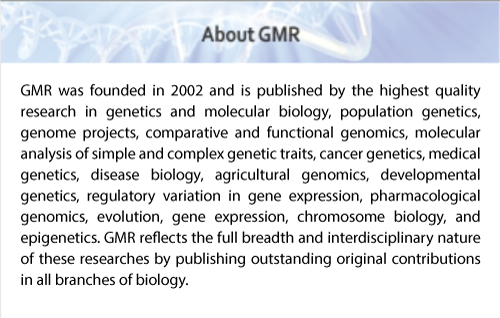
Google scholar citation report
Citations : 74024
Genetics and Molecular Research received 74024 citations as per google scholar report